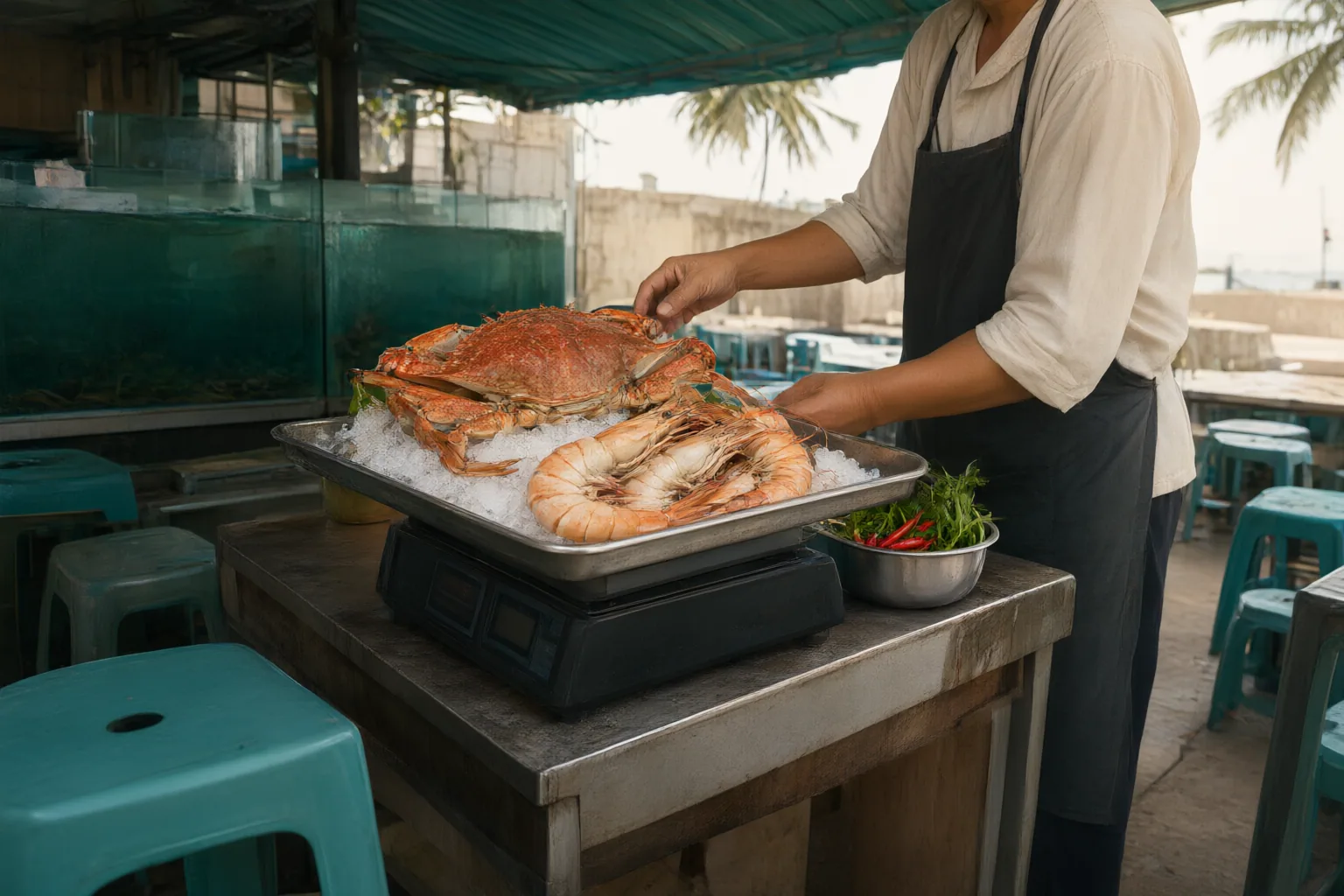
At many coastal seafood eateries in Vietnam, diners select seafood, verify its weight and price per kilogram, choose a cooking method, and confirm any preparation charges before cooking. The key is to agree on each part of the order while the selected item and scale reading are still visible.
How weight-based seafood ordering works
Traveler-focused dining guides describe a straightforward sequence at many seafood restaurants in Vietnam. Live seafood may be displayed in tanks, and diners choose a particular fish, crab, shrimp, or other item. The restaurant weighs that selection and cooks it to order.
Before preparation begins, establish that the quoted rate is per kilogram and confirm the weight assigned to the selected seafood. These two figures determine the seafood portion of the bill, so neither should be left implicit. A displayed number may be misunderstood as either a kilogram rate or the total for the item unless the unit is stated clearly.
The next step is choosing how the seafood will be cooked. A Da Nang dining guide lists grilled, steamed, tamarind, salt-fried, and garlic preparations among common options. The broader ordering guidance also recommends asking whether cooking or sauce carries a separate fee. The complete sequence is therefore: identify the exact seafood, verify its weight, confirm the price per kilogram, select the preparation, and settle any additional charges before approving the order.
What to confirm before the seafood is cooked
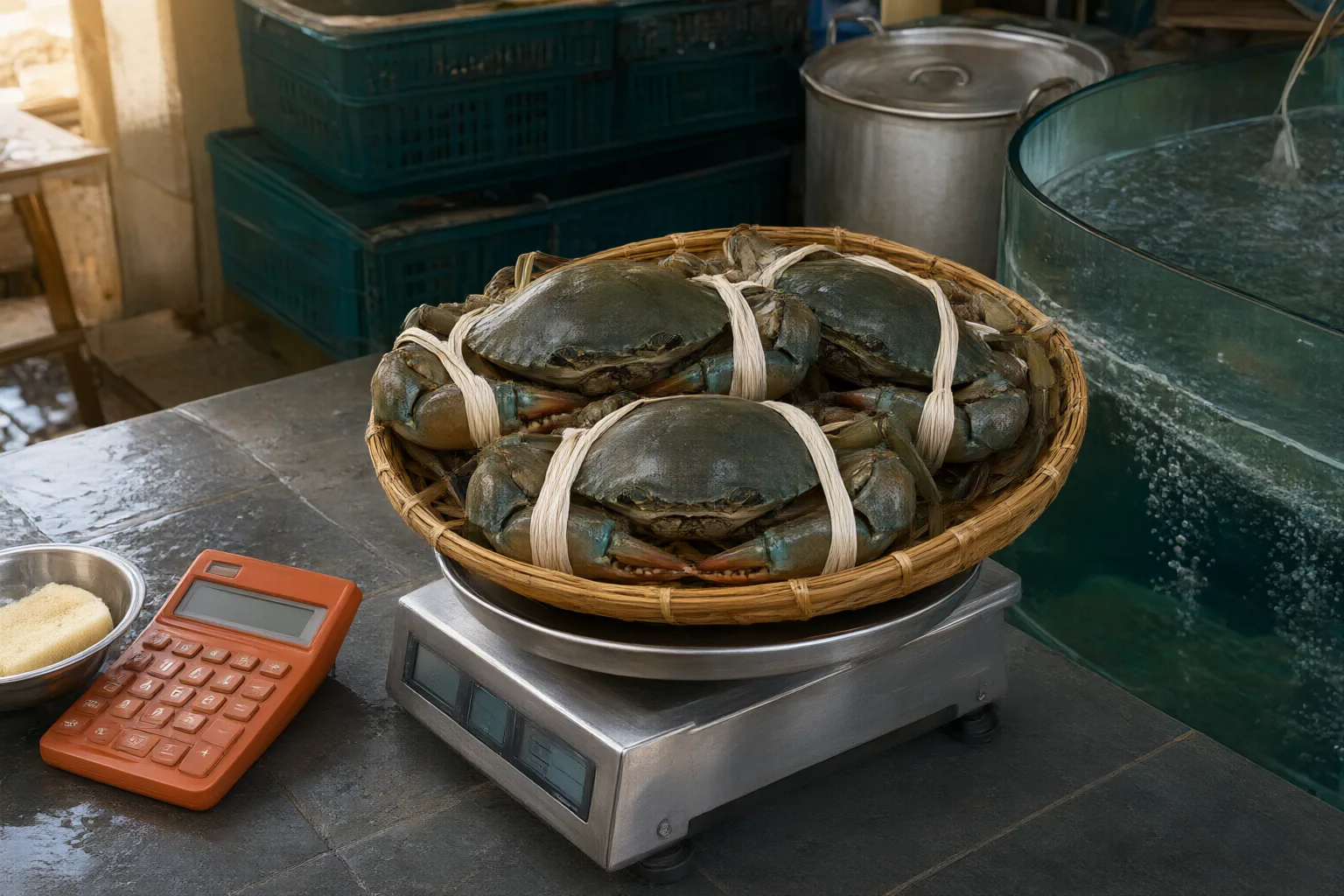
Start by making sure the staff and diners are referring to the same seafood. Then watch the weighing or ask to verify the scale reading. Confirm both the numerical weight and its unit rather than relying only on the size or appearance of the item.
Next, determine whether the displayed or spoken amount is the rate for one kilogram or the total price for the selected seafood. The sourced Vietnamese phrase “Cái này bao nhiêu 1 ký?” asks how much the item costs per kilogram. Travelers can use it while pointing to the selection, then repeat or otherwise verify the quoted rate and weight before cooking begins.
Finally, ask what the preparation adds to the bill. Cooking and sauce fees may be separate from the weight-based seafood charge, so the kilogram rate alone may not represent the final cost. Confirm the cooking method and any related fee, including a sauce charge where relevant. This creates a shared record of the important order details before the seafood leaves the weighing area: the selected item, its measured weight, its price per kilogram, the requested preparation, and any added cooking or sauce cost.
Why purchased weight is not the same as edible seafood
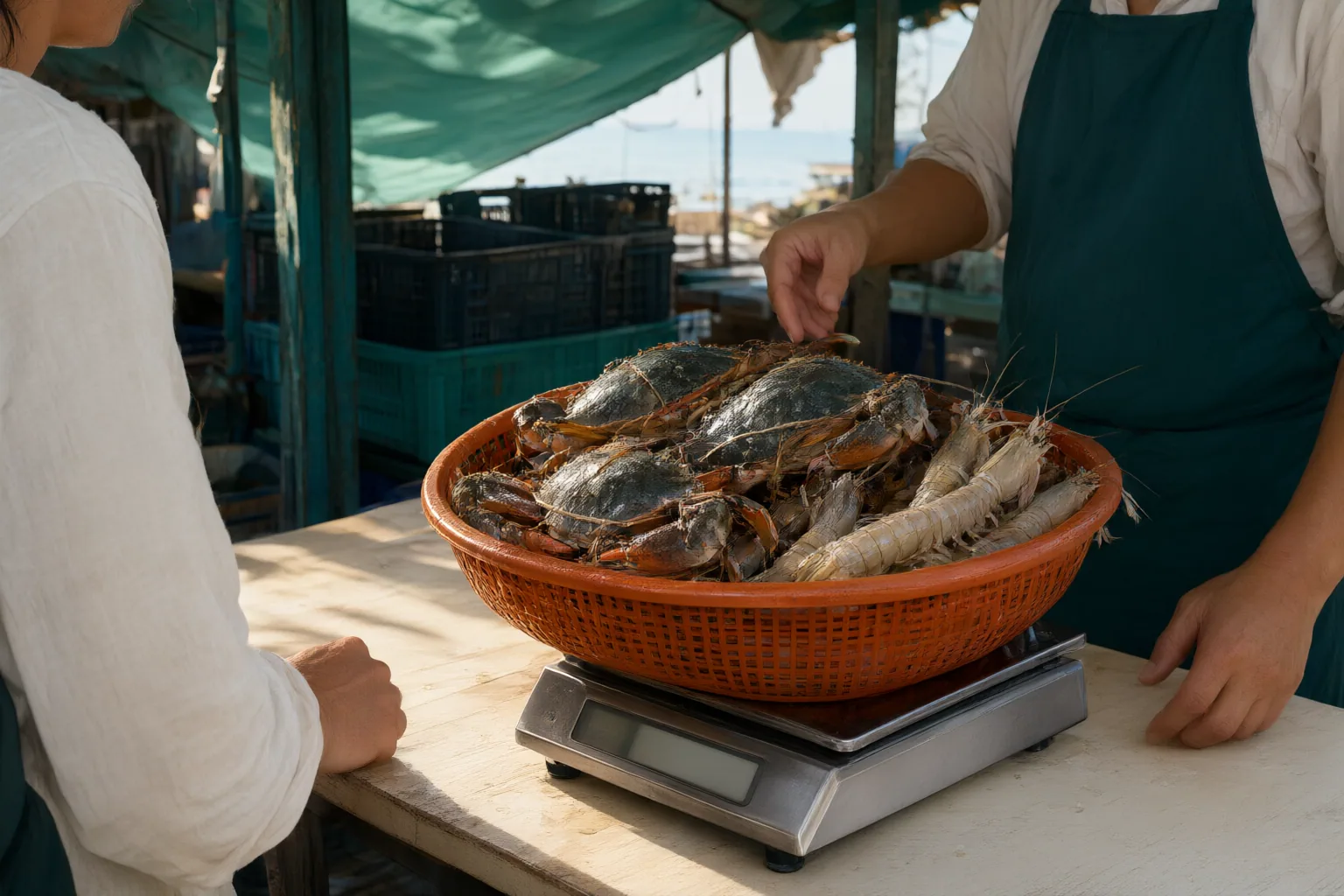
The scale measures the seafood as sold, not necessarily the portion that will be eaten. A whole fish can include bones, head, skin, and other non-edible weight. Crab and shell-on shrimp similarly include shells and other parts outside the edible meat. Planning references specifically indicate that whole fish contains non-edible weight and that obtaining a given edible amount from shell-on shrimp requires a greater purchase weight than obtaining it from peeled shrimp.
This distinction matters when comparing choices. One kilogram of whole or shell-on seafood does not provide one kilogram of meat, and equal purchased weights of differently prepared products need not produce equal edible portions. The available sources establish the direction of that difference but do not supply a universal yield for every species or restaurant, so a single conversion should not be assumed.
Size terminology also needs context. Seafood labels and measurement practices may vary locally, and descriptive names such as “jumbo” are not necessarily standardized. In seafood trade notation, a shrimp count such as 10/25 represents an approximate number of shrimp per pound; a lower count generally means larger individual shrimp. That convention can help explain size information when it is used, but it should not be treated as a universal restaurant labeling system. For a practical comparison, focus on the actual item, measured weight, stated unit, and condition—whole, trimmed, peeled, or shell-on—rather than a size name alone.
Conclusion
A weight-priced seafood order is easiest to understand when every charge is confirmed before preparation. Identify the exact seafood, watch or verify the scale reading, and establish that the quoted amount is the price per kilogram. Then choose the cooking method and ask whether cooking or sauce fees will be added.
Remember that the purchased weight of whole fish or shell-on seafood includes more than edible meat. Before the kitchen starts cooking, point to your selection and confirm its weight, price per kilogram, preparation method, and all stated cooking or sauce charges.
Disclosures and limitations
- This article was prepared with AI assistance exclusively from the supplied travel-dining, seafood-measurement, and yield references. It does not represent firsthand purchasing, testing, or legal guidance, and no current prices are presented.
Related reading
- Food & Drink Guides for Curious Travelers
- Common Menu Terms in Vietnam: A Practical Guide to Reading and Ordering
Sources
- Da Nang Seafood: What to Order, Where to Go — Breeze Vietnam
- Seafood Sizes, Weights, Measures – Fresh Seafood — fresh-seafood.net
- Complete Vietnam Seafood Guide — Types, Prices, and How to Order 2026 — VietinKo
- How Much Seafood Per Person? Portion Size Guide — Intershell Seafood
- Seafood Per Person Calculator | Portion Fish & Shellfish Fast – Handy Chefdom — Handy Chefdom