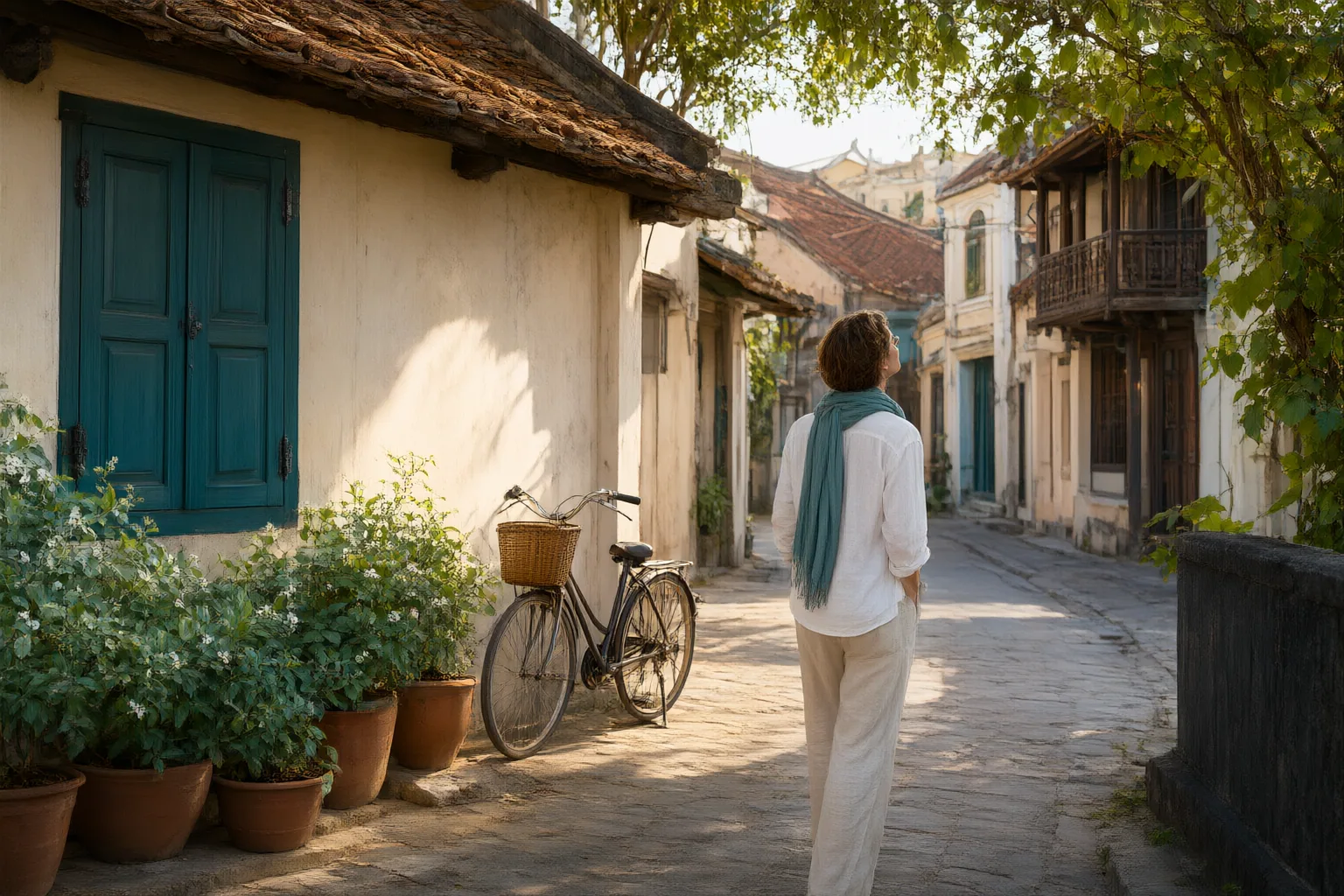
Choose a guided heritage walking tour when interpretation, help with complexity or language, and social interaction matter most. Explore independently when privacy, spontaneous stops, and control over your pace are the priorities. In either case, confirm local route conditions, accessibility, and reservation requirements before setting out.
What changes when you explore with a guide?
A guided walk gives the day a defined route and an interpreter. As an example of how heritage organizations describe this format, the LA Conservancy says its small-group tours use knowledgeable guides to explain local history, architecture, neighborhoods, people, and cultural touchstones. That example concerns Los Angeles, not Vietnam, but it illustrates the central benefit: a guide can connect individual buildings and streets to a broader story.
A commercial comparison published by Tour in a Box argues that a guide may be particularly useful at historically complex sites, when language causes friction, when a route needs real-time adjustment, or when travelers want social interaction. These are the provider’s judgments rather than independent findings, but they offer practical questions for evaluating a historic-town visit. Would signs or a guidebook supply enough context? Would uncertainty about language or navigation consume limited time? Would conversation with a guide or group make the experience more rewarding?
The tradeoff is reduced autonomy. A group generally follows a shared route and schedule, so an individual traveler may have less freedom to linger over one detail, change direction, or pause unexpectedly. Before booking, decide whether interpretation and assistance are worth accepting that structure.
When independent exploration offers more freedom
Independent exploration suits travelers who want to decide what happens next throughout the day. The Tour in a Box comparison associates this approach with privacy, spontaneous stops, and control over pace. That can matter when you want to spend longer at one place, leave another quickly, stop for food or coffee, or change direction without coordinating with a group.
Going without a live guide does not necessarily mean walking without structure. Clio, a nonprofit, provides a website and mobile app that link nearby historical and cultural sites through text and audio tours. This demonstrates how self-guided resources can connect physical places with historical context while leaving timing in the traveler’s hands. It does not establish that Clio or an equivalent service covers a particular Vietnamese town, so check what local materials are actually available.
The main question is whether those materials meet your needs. A mapped route, text, or audio may be enough if you are comfortable navigating and interpreting information yourself. If local signage is unclear, language creates anxiety, or the history is difficult to piece together, the freedom of traveling alone may come with more preparation and uncertainty.
Practical checks before choosing either format
Start with the physical route, not merely the subject of the tour. Ask about total distance, expected duration, hills, stairs, surfaces, opportunities to sit, weather exposure, and the amount of standing. The LA Conservancy, for example, says most of its walks cover one to two miles on city streets, may involve hills or stairs, provide few chances to sit, and require readiness to stand for two hours. These figures describe its Los Angeles tours only, but the categories are useful when questioning any operator.
Accessibility needs should be checked directly. The same organization notes that not all its tours are wheelchair accessible and advises visitors to ask which route fits their needs. For a Vietnamese town, do not assume that a general accessibility label answers every question: seek current details for the particular route and consider fatigue as well as mobility equipment.
Next, review booking conditions. Some LA Conservancy tours require advance registration, and its date-change policy requires contact at least 48 hours before the reservation. Local rules may be entirely different, so confirm the actual operator’s registration, cancellation, and change terms. Also ask what to bring and whether conditions alter the route.
Finally, compare formats rather than assuming the choice is simply “tour or no tour.” Heritage organizations may offer walking, virtual, self-guided, and private options. A self-guided resource or private arrangement could provide a better balance of context, pace, and accessibility when available locally.
Conclusion
Choose a guided heritage walk when expert interpretation, help navigating complexity or language, and a social experience outweigh the limits of a shared schedule. Choose independent exploration when privacy, spontaneous stops, and control over pace matter more, especially if reliable text or audio resources can supply the context you need.
Neither format is automatically suitable for every traveler or town. Published examples show why distance, terrain, seating, wheelchair access, reservations, and change policies deserve attention, but they do not establish current conditions in Vietnam. Before deciding, check the specific route, terrain, accessibility, reservation terms, and available self-guided resources, then select the format that fits your pace and need for historical context.
Disclosures and limitations
- This article was prepared with AI assistance using only the supplied research package and its identified sources; it does not report personal travel, product testing, or interviews.
- Examples from the LA Conservancy concern Los Angeles, not Vietnam, and Tour in a Box is a commercial provider. No specific Vietnamese tour’s availability, price, accessibility, route condition, or quality is established here.
Related reading
- Travel Ideas for Meaningful Trips
- How to Choose a Vietnamese Cooking Class with Regional Ingredients and Home-Style Techniques
- How to Choose a Snorkeling Experience on Vietnam’s Coast
Sources
- Is a Guided Walking Tour Worth It? When Self-Guided Is the Better Choice | Tour in a Box Blog — Tour in a Box
- Walking Tours – LA Conservancy — LA Conservancy
- Clio – Tours — Clio
- Tours & Events – LA Conservancy — LA Conservancy