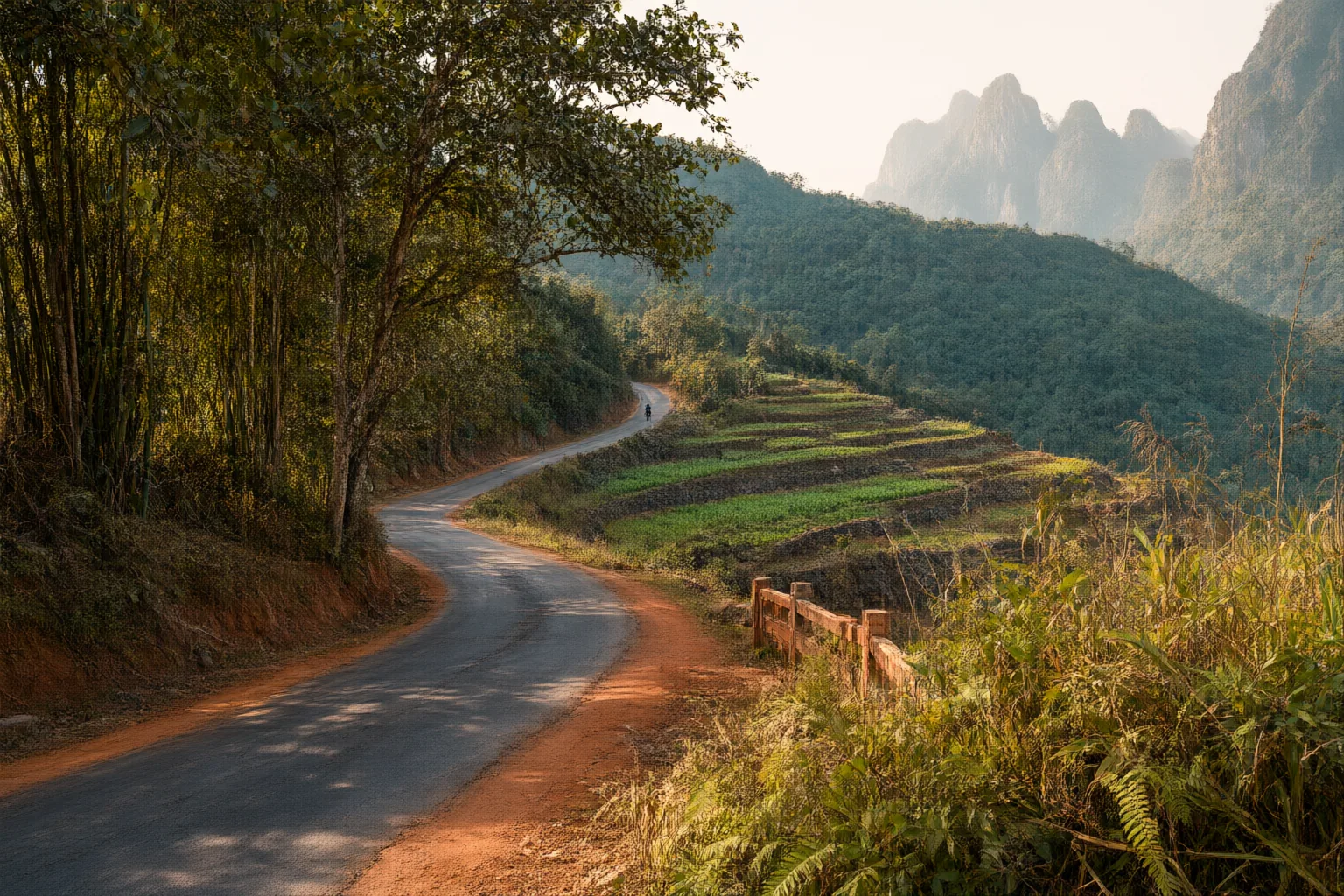
Assess a rural cycling route segment by segment rather than relying on distance or a “rural” label. Check each road for traffic, surface, climbing, weather exposure, shade, navigation reliability, and repair access, then judge whether the weakest section suits your bicycle, fitness, and ability to handle problems independently.
Check traffic exposure road by road
A route described as rural is not necessarily quiet from beginning to end. Divide the itinerary into city approaches, highways, secondary roads, village lanes, farm roads, and mountain sections. Published guidance describes city traffic as potentially chaotic and mountain traffic as generally lighter, while one travel publisher characterizes Ninh Binh backroads as carrying little traffic. These broad descriptions are useful starting points, not evidence about every segment.
For each road, note where the route joins a highway, crosses a town, or uses a paved connector. Seek current local confirmation because traffic can differ sharply among nearby roads and change after a route description is published. Consider the likely time of day as well as the road type. If exposure cannot be established, treat that uncertainty as part of the risk rather than assuming rural scenery means low traffic.
Where traffic is expected, allow more time and plan to ride predictably. MTB Vietnam advises avoiding sudden movements and using lights and reflective equipment. A route that depends on several uncomfortable traffic sections may need to be revised even when its quieter portions appear suitable.

Match surfaces, climbing, and weather to the rider and bike
Map the surface of every section instead of assigning one condition to the entire route. A northern Vietnam gravel-route example includes narrow tarmac, hard-packed gravel, farm roads, broken edges, rough patches, and paved connectors. Record both the expected surface and the confidence of that information. Broken asphalt or degraded edges can make a stage substantially harder than its distance suggests.
Review climbing as a pattern, not only as a total. Repeated or irregular climbs can accumulate fatigue, particularly in humid conditions. Combine elevation, surface, traffic, and likely riding time when estimating whether a day is manageable. The route example emphasizes that ride quality depends on surface choice, traffic rhythm, climbing pattern, weather window, and how daily stages connect.
Use those conditions to make a broad bicycle-fit check. The supplied guides describe gravel bikes as suitable for mixed terrain, mountain bikes as appropriate for dirt trails and rough remote areas, and road bikes as better suited to smoother paved or coastal sections than rough mountain roads. This does not guarantee suitability for a particular itinerary.
Finally, check recent weather and current road conditions locally. MTB Vietnam warns that heavy rain may bring mud, flooding, landslides, and reduced visibility, while mountain weather—especially in northern areas—can change quickly. If rain could turn a difficult section into an impassable or poorly visible one, build in an alternative or postpone.
Verify shade, navigation, and repair access separately
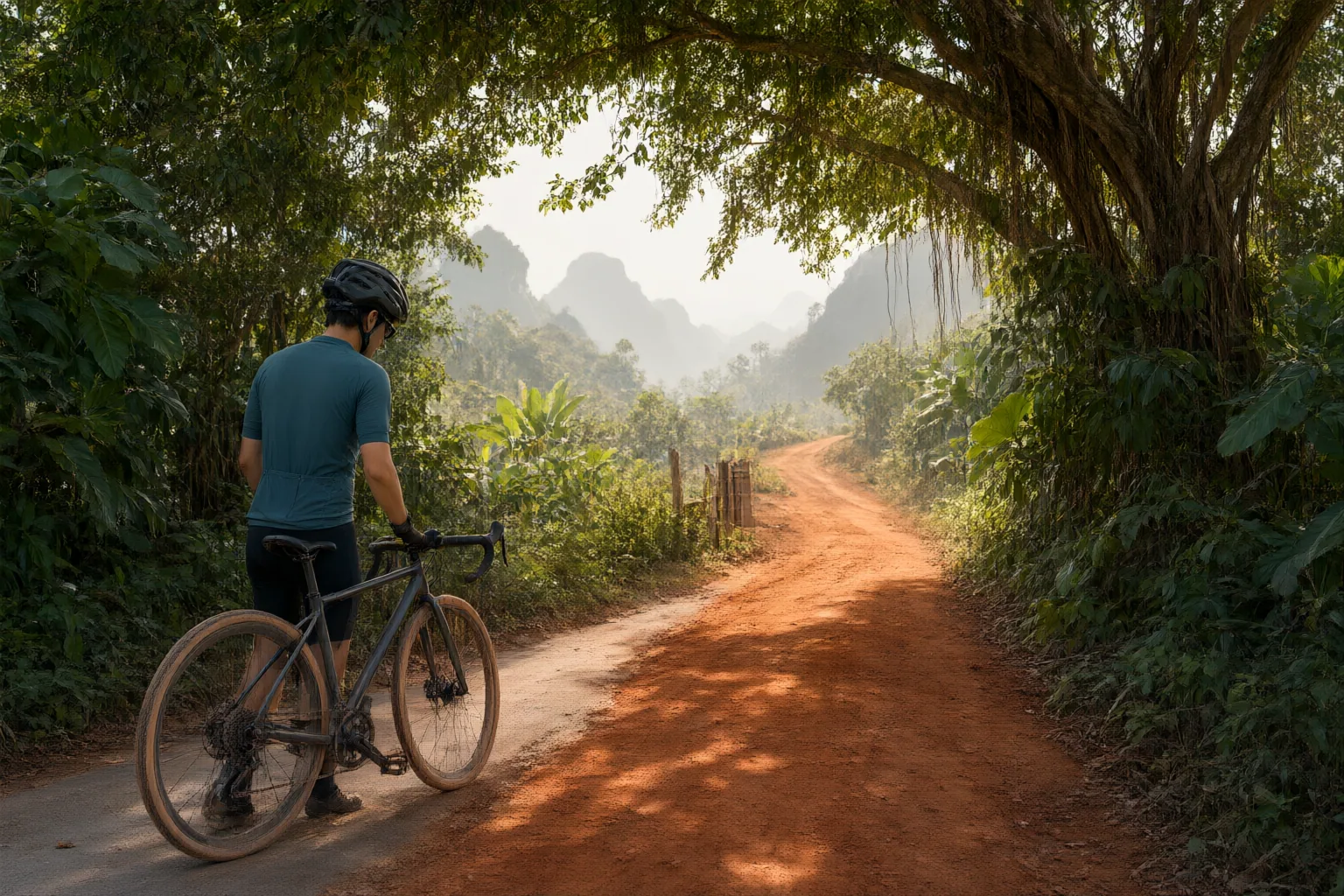
Do not infer shade from green scenery, a regional description, or the presence of fields. The supplied sources discuss heat, humidity, early starts, and weather but provide no segment-level shade measurements. Check shade independently using current local imagery, mapping, or local confirmation. Identify exposed sections and consider when they would be ridden; if shade remains uncertain, plan as though protection may be limited.
Prepare navigation for a loss of mobile service. Two MTB Vietnam guides recommend downloading offline maps because coverage can be limited or disappear in remote mountain areas. Save the complete route and important junctions before departure, and have an alternative way to follow the itinerary if the primary phone or application fails.
Mechanical support also needs a separate check. The same guides say bicycle shops may be difficult to find in remote areas and recommend carrying basic repair supplies. Mark any support locations that can be confirmed, but do not assume a general repair business can handle every bicycle or part. Consider the distance between possible help points, the surfaces most likely to cause trouble, and which basic problems the rider can address roadside.
Before departure, recheck all three categories. Shade, reception, road access, and available services can differ from what a general route summary implies, so unresolved gaps should influence the decision to ride, revise, or delay.
Conclusion
Make the final decision according to the route’s weakest segment, not its total distance or most attractive section. Choose go only when the traffic, surfaces, climbing, weather exposure, navigation plan, and repair preparation are suitable throughout. Choose revise when an uncertain highway connection, rough section, exposed stretch, or unsupported area can be bypassed or shortened. Choose postpone when current weather, road damage, visibility, or an unresolved support gap could make the ride unsuitable.
Published guides provide useful planning context, but they are not current audits of individual roads. Before riding, review the route segment by segment, download offline navigation, confirm present traffic, road, shade, and weather conditions locally, and carry repair supplies appropriate to the expected terrain.
Disclosures and limitations
- This article was prepared with AI assistance from the supplied research package and cycling or travel-publisher sources. The sources offer general guidance rather than current segment-by-segment audits, so local conditions should be verified before departure.
Related reading
- Destinations for Curious Trips and Meaningful Stops
- Restored Heritage Buildings in Vietnam: How to Assess Comfort Before You Book
- Entering a Vietnamese Pagoda: Clothing, Photography, Offerings, and Quiet Conduct
Sources
- Vietnam Cycling Tips 🇻🇳 | Essential Guide for Bike Tours & MTB Adventures — MTB Vietnam
- U.S. Bicycle Route System – Adventure Cycling Association — Adventure Cycling Association
- Cycling in Vietnam: The Ultimate Guide (Routes, Safety & Tips) — kampatour.com
- Designing accessible rural active travel — GOV.UK
- Vietnam Cycling Route Example for Gravel Riders – Cycling Nature Experience — Cycling Nature Experience
- Self-Guided Cycling Vietnam 🇻🇳 | Best Routes, Tips & Bikepacking Guide — MTB Vietnam
- Interactive Network Map – Adventure Cycling Association — Adventure Cycling Association